For Parents

Help your child strengthen their literacy skills at any stage of development.

Your family plays a big role in helping your child learn to read and write. With the right phonics activities at home, you can support your child’s literacy development and academic success. The more you understand how and why phonics instruction works, the better you can facilitate effective and meaningful learning experiences with your family. 

To help your child practice phonics at home, read our insights for parents below! You can also browse our phonics program reviews for more.

Phonics Education for Families

Discover how classic nursery rhymes like 'There Was an Old Lady' and 'Humpty Dumpty' can be powerful phonics teaching tools for early readers.

Nursery Rhymes as Phonics Tools

Did you know that the nursery rhymes you loved as a child could be...

Learn age-appropriate vocabulary benchmarks, the science behind word knowledge development, and practical activities parents can use to expand their child's word bank at home.

Vocabulary Development: How Phonics Builds Word Knowledge in Early Readers

The excited squeal of “I know that word!” from your child during storytime. The...

Discover the best books for teaching phonics to your young reader. Our curated list pairs quality children's literature with specific phonics skills to make learning to read engaging and effective.

The Ultimate Master List of Phonics Books: Organized by Reading Skills

Picture this: Your child’s eyes light up as they successfully sound out a word...

Discover how speech sound development impacts your child's reading journey.

Speech Sound Development Chart: What Parents Need to Know

Learning to speak is one of the most remarkable feats of early childhood. As...

Discover how Lewis Carroll's 'Jabberwocky' and other nonsense literature can strengthen phonics skills in early readers.

The Wonderful World of Nonsense: Using Jabberwocky to Boost Early Reading Skills

The strange creatures and bizarre vocabulary of The Jabberwocky offer more than just giggles—they...

Learn the magic e rule, explore common examples for PreK readers, and discover fun activities to practice this essential phonics pattern at home.

Silent E Words Help Your Child Master Long Vowel Sounds

Learning to read involves many small steps that build upon each other. Among these...

Discover the science-backed roadmap for teaching children to read with our comprehensive guide to phonics scope and sequence.

Scope and Sequence for Early Reading: Your Guide to Phonics Instruction

Did you know that there’s a scientific roadmap for teaching children to read? Many...

Discover effective multisensory techniques, fun activities, and practical strategies to support your child's phonics development and build a strong foundation for reading success.

Short Vowel Sounds: A Parent’s Guide

A child’s literacy journey begins with learning the fundamental building blocks of reading, and...

Discover why children sometimes experience reading regression, how to identify it, and practical phonics activities to help your child regain confidence and skills.

What to Do When Reading Skills Regress

Has your child suddenly started struggling with words they used to read with ease?...

Learn 25 common root words and practical activities to help your child connect decoding skills with meaning, boosting reading comprehension and academic success.

Root Word Meaning: Building Vocabulary Through Phonics

Have you ever watched your child struggle with an unfamiliar word, sounding it out...

IEP Goals and Phonics: What to Ask For and Why

IEP Goals and Phonics: What to Ask For and Why

If you’ve already sat through an IEP meeting and walked out feeling like the reading goals were soft, vague, or weirdly disconnected from what your child actually needs, you’re not…


How To Use Phoneme-Grapheme Mapping at Home

How To Use Phoneme-Grapheme Mapping at Home

When your child writes “sip” instead of “ship,” they’re not making a careless mistake. They’re missing a small but important skill. They haven’t yet learned that two letters, “s” and…

Sight Words and Phonics: Friends, Not Enemies

Sight Words and Phonics: Friends, Not Enemies

If you’ve spent any time in early literacy circles, you’ve probably noticed something strange: people argue about sight words. One camp says memorizing sight words is essential. Another says it’s…
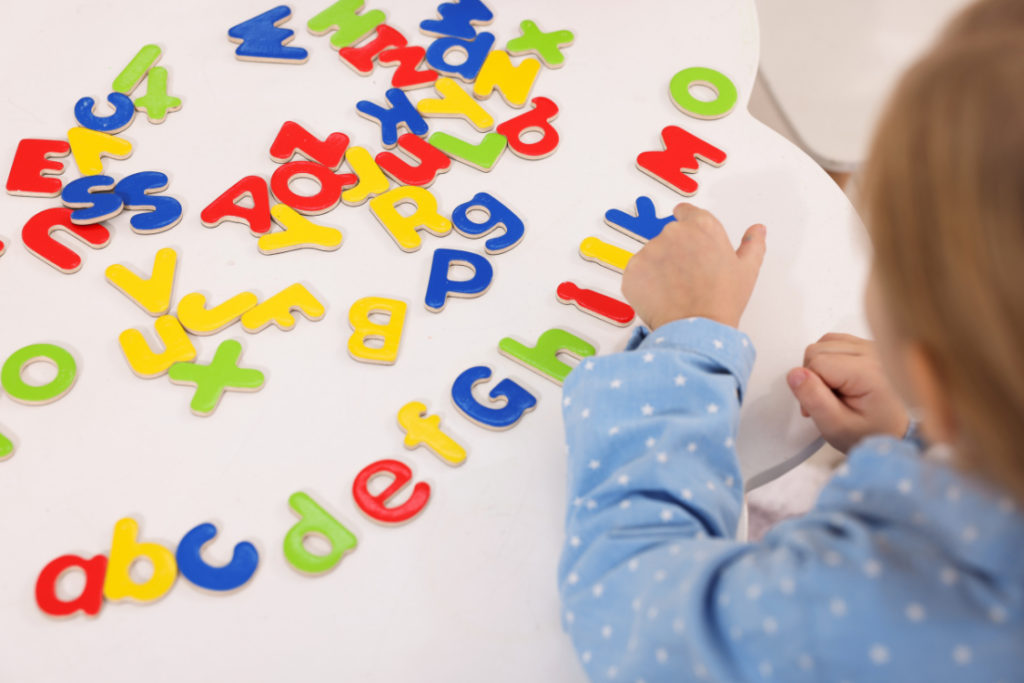
Word Sorting: The Low-Tech Phonics Strategy with Big Results

Word Sorting: The Low-Tech Phonics Strategy with Big Results

Among kindergarten teachers, word sorting holds a quiet kind of reverence. It asks for nothing more than a small pile of word cards and a child willing to look closely,…

Dictation as a Phonics Tool: Why Writing Reinforces Reading

Dictation as a Phonics Tool: Why Writing Reinforces Reading

Most parents and teachers think of reading and writing as separate skills taught at different times of day. Reading comes first, the thinking goes, and writing follows once a child…

Decodable vs. Leveled Readers: Which Belongs in Your Child’s Hands

Decodable vs. Leveled Readers: Which Belongs in Your Child’s Hands

Walk into any kindergarten classroom, and you will see two very different books being handed to children learning to read. One says, “Sam can tap. Sam can nap.” The other…

Cumulative Review in Phonics: The Strategy Most Programs Skip

Cumulative Review in Phonics: The Strategy Most Programs Skip

When a child learns the short /a/ sound on Monday, blends CVC words on Tuesday, tackles digraphs on Wednesday, and then never returns to short /a/ again, something strange happens.…

Phonics Scope and Sequence: What It Is and Why It Matters

Phonics Scope and Sequence: What It Is and Why It Matters

Imagine handing a child a jigsaw puzzle with no picture on the box and no guidance about where to begin. A few kids might figure it out eventually, but most…

How to Structure a Phonics Lesson From Start to Finish

How to Structure a Phonics Lesson From Start to Finish

Here’s something that might surprise you: the order of a phonics lesson matters almost as much as the content inside it. A child who sits down for 20 minutes of…

Progress Monitoring in Phonics: What Parents Should Be Asking Schools

Progress Monitoring in Phonics: What Parents Should Be Asking Schools

Most parents only hear about reading problems when it’s already late in the game. A vague comment at a parent-teacher conference, a worrying score on a state test, a teacher…